OEM Kitchen Scales: What Retailers and Brands Should Consider
For retailers and brands, selling a kitchen scale under your own brand can be more than simply adding a logo to an existing product.
A successful OEM kitchen scale project needs to consider product specifications, target consumers, design, packaging, quality, compliance, MOQ and retail positioning from the beginning.
Whether you are developing your first private-label kitchen scale or expanding an existing kitchenware range, choosing the right product and supplier can make the development process much easier.
So, what should retailers and brands consider when developing an OEM kitchen scale?
1. Start with Your Target Market
Before discussing colors, logos or packaging, define who the product is for.
Different consumer groups may require very different kitchen scales.
For example:
Everyday Home Cooks
They may prefer:
- Simple operation
- 1g measurement
- Practical capacity
- Easy-to-clean design
- Competitive retail price
Home Bakers
They may place more importance on:
- Measurement precision
- Tare function
- Clear display
- Multiple units
- Stable readings
Coffee Enthusiasts
They may prefer:
- Higher precision
- Compact design
- Fast response
- Easy-to-read display
- Modern appearance
Premium Kitchenware Consumers
They may expect:
- Stainless steel or tempered glass
- Refined design
- Premium packaging
- Higher perceived product value
The first step in an OEM project should therefore be understanding the target consumer and retail channel.
2. Choose the Right Product Specification
Once the target market is clear, you can determine the appropriate specifications.
Important factors include:
- Maximum capacity
- Measurement increment
- Platform size
- Display
- Measurement units
- Tare function
- Power supply
- Product dimensions
- Materials
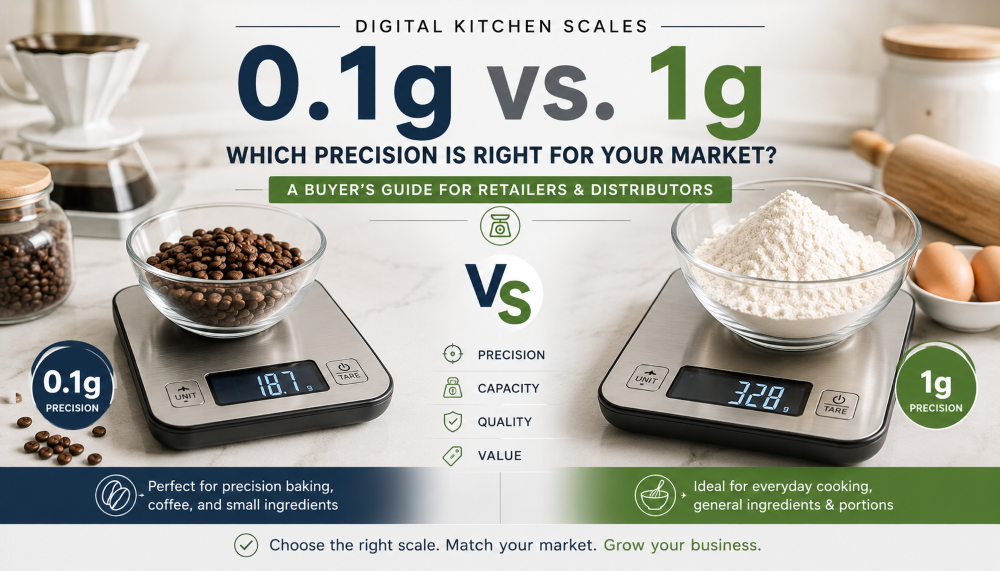
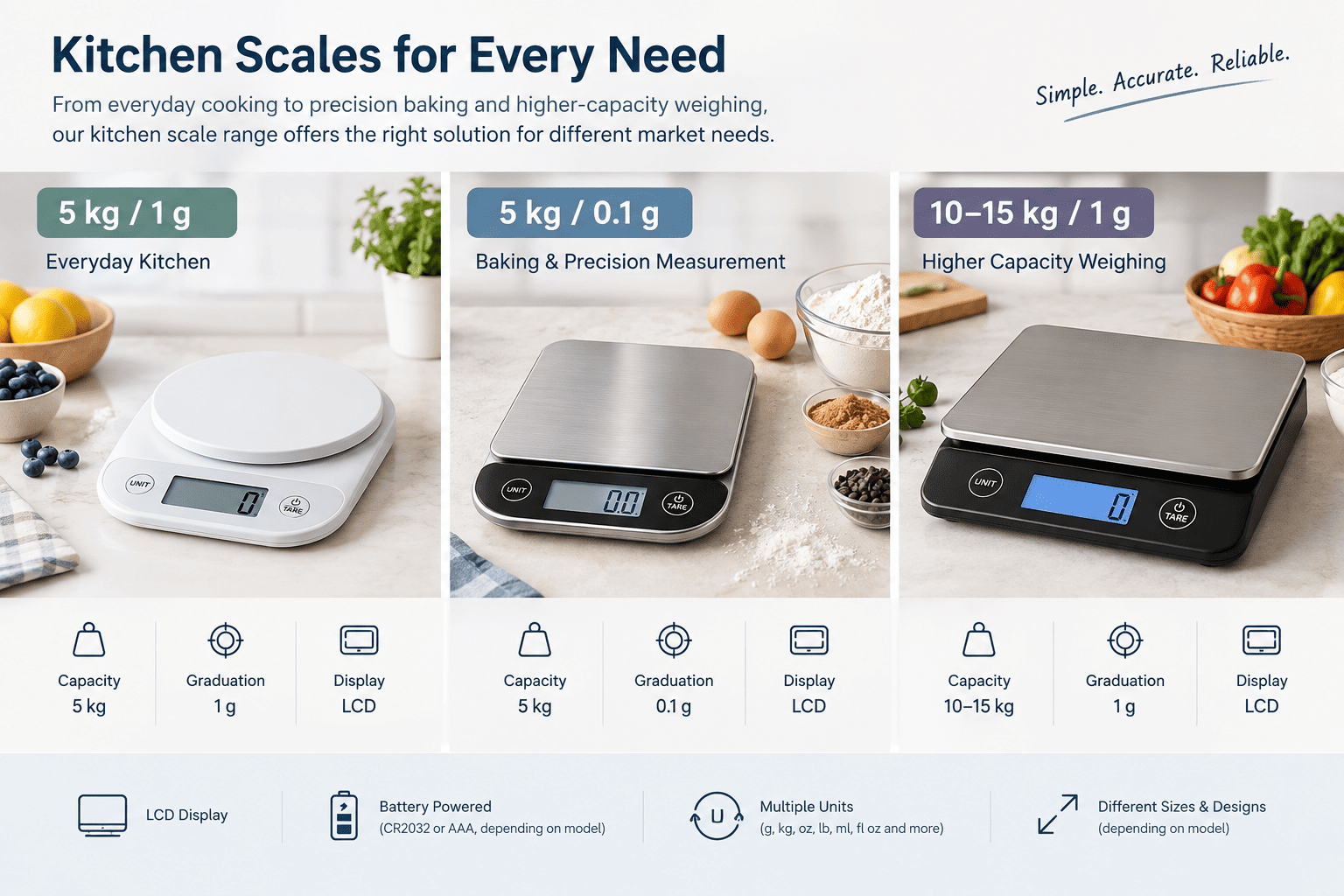
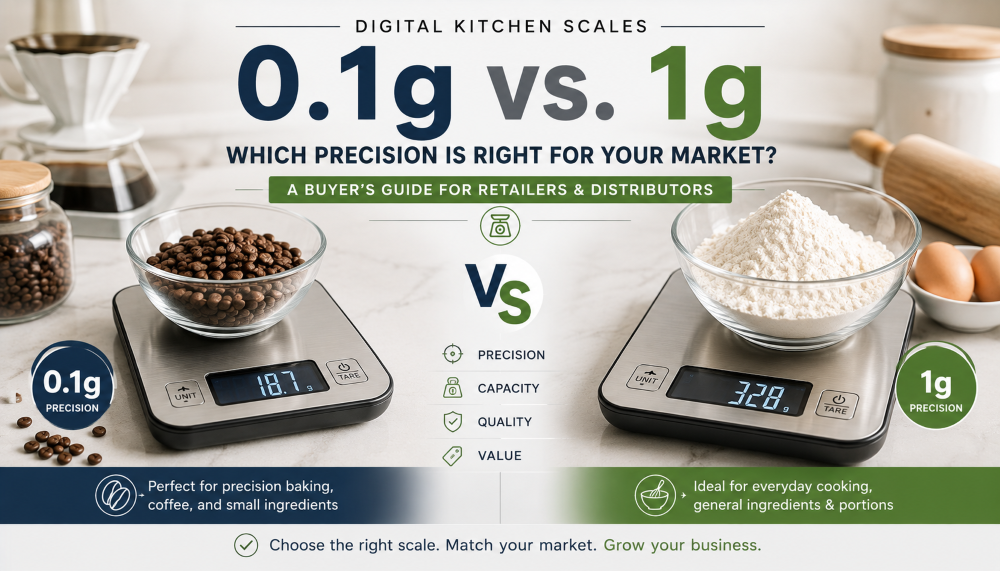
For example, a general household model may use 1g measurement, while a precision model designed for baking or coffee may offer 0.1g measurement.
Neither specification is automatically better.
The right specification is the one that matches the intended application and retail positioning.
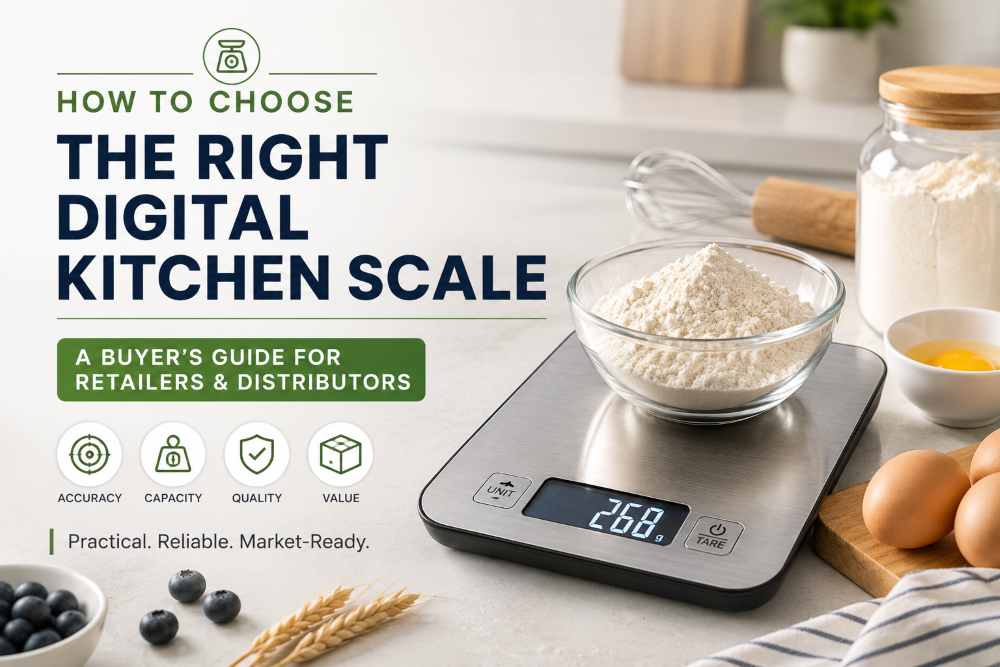
For a broader product-selection framework, see our guide on How to Choose the Right Digital Kitchen Scale for Your Market.
If you are comparing different precision levels, see our guide:
0.1g vs. 1g Kitchen Scales: Which Precision Is Right for Your Market?
3. Decide How Much Customization You Need
OEM does not always mean developing a completely new product from scratch.
There are different levels of customization.
Basic OEM
The buyer selects an existing model and customizes:
- Logo
- Product color
- Packaging
- User manual
This can be a practical solution for buyers who want to launch a private-label product efficiently.
Product-Level Customization
More extensive projects may include:
- Customized housing color
- Button design
- Display design
- Materials
- Product dimensions
- Functional specifications
This can help create a more distinctive product.
ODM Development
For brands looking for something more unique, the supplier may also support product development based on specific requirements.
The appropriate level depends on your budget, target price, expected sales volume and development timeline.
4. Choose a Design That Fits Your Brand
A kitchen scale is both a functional product and a piece of kitchenware.
Its appearance can influence how consumers perceive the product.
For example:
Minimalist
Clean lines, neutral colors and a simple interface can suit modern kitchenware collections.
Professional
Stainless steel surfaces and stronger construction can create a more professional appearance.
Premium
Tempered glass, refined details and premium packaging can support a higher retail positioning.
Value-Oriented
Simple construction and essential functions can help achieve a competitive price.
The design should therefore fit the overall visual identity of your brand.
5. Consider Materials Carefully
Material selection affects both appearance and product cost.
Common kitchen scale platform materials include:
- Tempered glass
- Stainless steel
- Plastic
- ABS or other engineered plastics
Each option provides a different combination of appearance, durability, weight and cost.
For example, stainless steel can provide a practical and professional appearance, while tempered glass can create a clean and modern look.
For products intended for food-related use, buyers should also make sure that applicable materials meet the requirements of the destination market.
6. Packaging Is Part of the Product
For private-label products, packaging should be considered from the beginning.
A well-designed package can help:
- Communicate the product's key features
- Build brand recognition
- Protect the product
- Improve retail presentation
- Support e-commerce sales
- Meet retailer requirements
Depending on the sales channel, packaging options may include:
- Customized color box
- White box
- Brown box
- Blister packaging
- Retail-ready packaging
Important information may include:
- Product name
- Main features
- Capacity
- Measurement precision
- Measurement units
- Product dimensions
- Barcode
- Brand information
- Instructions
- Required market labeling
For international projects, packaging should be reviewed before mass production.
7. Think About MOQ and Target Cost
One of the biggest questions in an OEM project is usually:
How many units do we need to order?
MOQ can depend on factors such as:
- Existing product model
- Product color
- Customized components
- Packaging
- Printing
- Tooling
- Production requirements
A standard model with existing components may allow a more flexible starting quantity.
A highly customized product may require a higher MOQ because of additional development and production costs.
Buyers should also define their target cost early.
A useful approach is:
Target Retail Price
↓
Target Product Cost
↓
Required Features & Materials
↓
Packaging
↓
MOQ & Production Plan
This helps prevent a common problem: developing a product that looks attractive but cannot achieve the desired retail price.
8. Ask for a Pre-Production Sample
A sample should be an important part of an OEM project.
Before mass production, buyers should check:
- Product appearance
- Color
- Logo
- Display
- Buttons
- Measurement performance
- Materials
- Packaging
- User instructions
If changes are required, they should be discussed and confirmed before production.
For larger projects, it is also useful to keep an approved sample as a reference for mass production.
This can help both the buyer and supplier maintain a clear understanding of the final product.
9. Check Quality and Production Consistency
OEM is not only about developing the first sample.
The bigger challenge is making sure mass production remains consistent with the approved product.
Quality control can cover:
Appearance
Check for scratches, color differences, printing defects and assembly issues.
Function
Check weighing performance, display, buttons, tare and unit conversion.
Materials
Verify that production materials match the approved specification.
Packaging
Check that the correct packaging, labels and manuals are used.
For long-term OEM projects, buyers should establish clear quality standards with the supplier before production.
10. Don't Forget Compliance
Different markets have different regulatory requirements.
Depending on the product and destination market, an OEM kitchen scale may involve requirements related to:
- Electrical safety
- Electromagnetic compatibility
- RoHS
- Battery requirements
- Food-contact materials, where applicable
- Packaging
- Labeling
- Other market-specific regulations
The exact requirements should be confirmed for the destination market and actual product configuration.
For buyers, it is important to ask the supplier for documentation related to the specific model being supplied, rather than relying only on general company certificates.
Compliance should be considered during product development rather than after production is completed.
11. Choose a Supplier That Can Support the Whole Project
A successful OEM project involves more than manufacturing.
You may need support with:
- Product selection
- Specification confirmation
- Sample development
- Color matching
- Logo application
- Packaging
- Testing
- Quality control
- Production
- Shipment
This is why supplier communication is particularly important.
Before starting an OEM project, ask:
- Who will manage the project?
- How quickly can samples be developed?
- What information is needed from the buyer?
- How are product changes confirmed?
- How are quality standards documented?
- What happens if production problems occur?
A supplier that communicates clearly can make the development process much easier.
OEM Kitchen Scale Development Checklist
Before confirming your project, make sure you have considered:
Market
- Who is the target consumer?
- What retail channel will you use?
- What is the target retail price?
Product
- What capacity is required?
- 1g or 0.1g?
- What platform material is suitable?
- Which units are needed?
- What power supply should be used?
Branding
- What logo should be used?
- Which colors match your brand?
- What level of product customization is required?
Packaging
- What packaging format is needed?
- What information must be printed?
- Is multilingual packaging required?
- Are barcodes or retailer labels needed?
Commercial
- What is the target cost?
- What is the MOQ?
- What is the expected annual volume?
- What is the required lead time?
Quality & Compliance
- What quality standard should be followed?
- What testing is required?
- What documents are needed?
- How will the approved sample be used during production?
Having these points clear before production can help reduce unnecessary revisions and delays.
Why Choose One Ants for OEM Kitchen Scales?
At One Ants, we supply kitchen and household products for retailers, distributors, importers and brands.
Our kitchen scale range covers different designs and specifications for different market requirements, including practical everyday models and precision-focused scales for baking and food preparation.
For OEM and ODM projects, we can support customers with:
- Product selection
- Product specifications
- Customized colors
- Logo application
- Retail packaging
- User manuals
- Sample development
- Product documentation
- Quality control
We understand that an OEM project is not simply about putting a logo on a product.
The goal is to develop a kitchen scale that fits your brand, target consumer, retail price and market requirements.
Whether you are launching a new private-label kitchen scale or expanding an existing kitchenware range, our team can work with you from product selection through production.
Conclusion
Developing an OEM kitchen scale requires more than choosing a product and adding a logo.
Retailers and brands should consider the target market, product specifications, design, materials, packaging, MOQ, target cost, quality control and compliance requirements from the beginning.
A clear product brief and reliable supplier can help make the development process more efficient and reduce unnecessary changes before mass production.
If you are looking for an OEM kitchen scale manufacturer for your brand or retail market, contact One Ants to discuss your product requirements.
How to Choose a Reliable Kitchen Scale Supplier in China