How to Choose a Reliable Kitchen Scale Supplier in China
China is one of the major sourcing markets for kitchenware and small household products.
For retailers, importers, distributors and private-label brands, working with the right kitchen scale supplier in China can provide access to competitive pricing, product variety and OEM/ODM opportunities.
However, choosing a supplier should not be based on price alone.
A low quotation may look attractive at the beginning, but product quality, communication, lead time, packaging, documentation and after-sales support can have a much greater impact on the overall cost of a project.
So, how can you evaluate a kitchen scale supplier before starting a long-term cooperation?
Here are some key factors to consider.
1. Check the Supplier's Product Experience
The first thing to consider is whether the supplier actually has experience with kitchen scales.
A supplier that specializes in kitchen and household products may have a better understanding of:
- Product specifications
- Common consumer requirements
- Kitchen scale design
- Packaging
- Quality control
- Export requirements
- Product development
Ask the supplier what types of kitchen scales they currently offer.
For example, their range may include:
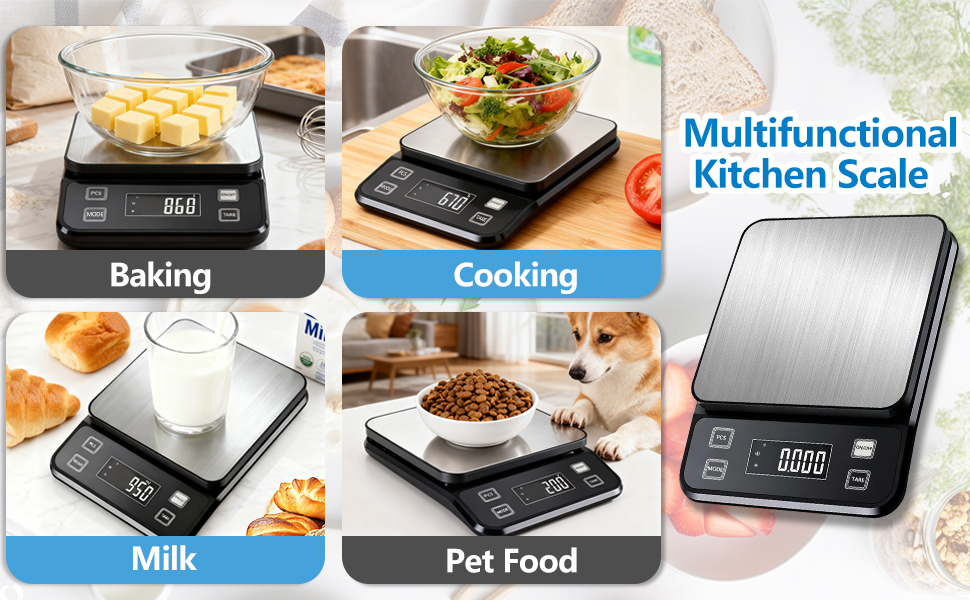
- Basic digital kitchen scales
- Stainless steel kitchen scales
- Tempered glass kitchen scales
- Precision kitchen scales
- Baking scales
- Coffee scales
- Different capacity options
A supplier with a broader product range may also be able to recommend different solutions for different market segments.
2. Evaluate Product Quality, Not Just the Sample Appearance
A sample is important, but looking at the sample is only the beginning.
When evaluating a kitchen scale supplier, consider how the supplier controls quality throughout production.
Important areas include:
- Weight measurement accuracy
- Reading stability
- Sensor performance
- Tare function
- Display quality
- Button performance
- Platform construction
- Battery compartment
- Product assembly
- Packaging protection
A good sample should represent the product that will actually be produced in larger quantities.
Buyers should therefore ask how the supplier manages quality consistency from the first sample to mass production.
3. Ask About the Sensor and Measurement Performance
The sensor is one of the most important components of a digital kitchen scale.
A product may look attractive, but its performance ultimately depends on how well the weighing system works.
When discussing a product with a supplier, consider:
- Maximum capacity
- Measurement increment
- Accuracy
- Repeatability
- Stability
- Calibration
- Response time
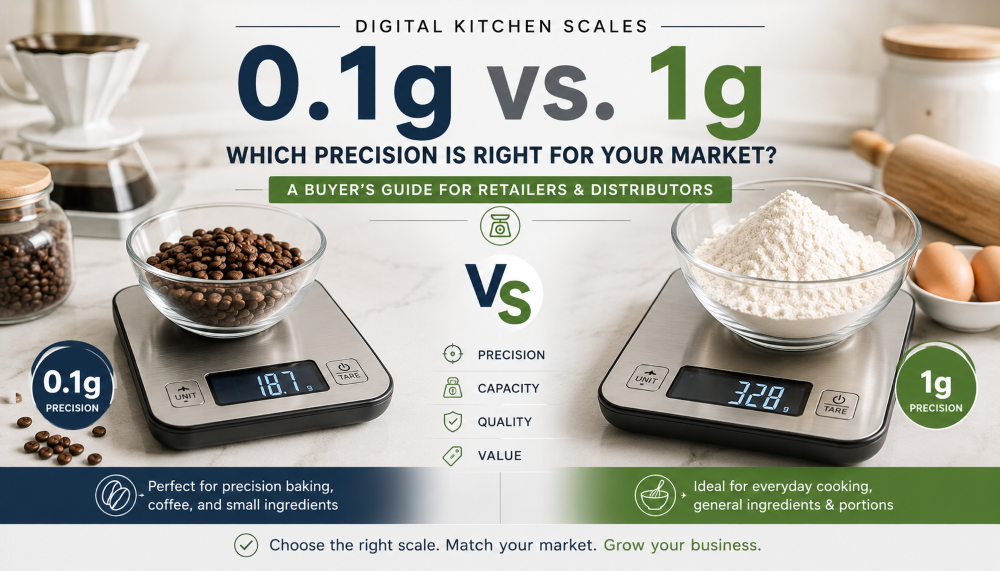
For example, a general household kitchen scale may use a 1g increment, while a precision model may offer 0.1g measurement.
The appropriate specification depends on the target market and application.
You can also refer to our guide on 0.1g vs. 1g kitchen scales when comparing different product options.

4. Look at the Supplier's OEM and ODM Capability
For retailers and brands, an existing product may not always be enough.
You may want to customize:
- Product color
- Logo
- Packaging
- Display design
- Product specifications
- Buttons
- Materials
- User manual
- Retail presentation
This is where OEM and ODM capability becomes important.
OEM
With OEM, the supplier manufactures a product according to your requirements or based on an existing product, with your branding and packaging.
ODM
With ODM, the supplier can provide product development or design solutions that can then be customized for your market.
Before starting a project, ask the supplier:
What parts of the product can be customized?
This can help you understand whether the supplier is simply selling standard products or can actually support product development.
5. Check Available Compliance Documentation
Compliance requirements vary depending on the product configuration and destination market.
For digital kitchen scales, buyers may need to consider areas such as:
- Electrical safety
- Electromagnetic compatibility
- RoHS requirements
- Battery-related requirements
- Food-contact requirements for applicable components
- Labeling requirements
- Market-specific regulations
For European markets, buyers may commonly request relevant CE and RoHS documentation, while food-contact materials may require appropriate testing depending on the product design and intended use.
The most important point is that the documentation should correspond to the actual product being supplied.
Do not simply ask:
"Do you have CE?"
Instead, ask:
"Can you provide the relevant test reports and declarations for this exact model?"
This can help avoid compliance problems later in the project.
6. Compare MOQ and Pricing Together
Price is obviously important for any sourcing project.
However, the lowest unit price is not always the lowest overall cost.
When comparing suppliers, consider:
- Unit price
- MOQ
- Packaging cost
- Printing cost
- Tooling cost, if applicable
- Sample cost
- Shipping
- Payment terms
- Lead time
For example, Supplier A may offer a lower unit price but require a much higher MOQ.
Supplier B may have a slightly higher unit price but offer a lower MOQ and more flexible packaging options.
For a new product launch, the second option may sometimes provide a better overall solution.
The right supplier should be able to balance cost, quality and flexibility.

7. Pay Attention to Packaging
Packaging is particularly important for retailers.
A kitchen scale may need to be sold through supermarkets, discount stores, specialty kitchenware stores, e-commerce platforms or other retail channels.
Different channels may have different packaging requirements.
Possible options include:
- Color box
- White box
- Brown box
- Blister packaging
- Customized retail packaging
Buyers should consider:
- Product protection
- Packaging size
- Shipping efficiency
- Retail presentation
- Branding
- Barcode
- Instructions
- Market-specific labeling
If you are developing a private-label product, discuss the packaging at an early stage instead of leaving it until the end of production.
8. Test Communication Before Placing a Large Order
Good communication is often underestimated when choosing a supplier.
A kitchen scale project can involve many details, including:
- Product specifications
- Samples
- Packaging
- Artwork
- Labels
- Manuals
- Testing
- Inspection
- Production schedules
If communication is already difficult during the quotation stage, managing a larger project may become even more challenging.
Pay attention to whether the supplier:
- Replies clearly
- Answers questions directly
- Understands your requirements
- Provides accurate specifications
- Follows up on open issues
- Communicates production changes in advance
A reliable supplier should not simply say "yes" to everything.
They should also be able to point out potential problems and suggest practical solutions.
9. Ask About Quality Control
Before placing an order, ask how the supplier controls product quality.
Depending on the project, quality control may include:
Incoming Material Inspection
Components and materials are checked before production.
Production Inspection
Production is monitored to identify problems at an early stage.
Finished Product Inspection
Finished products are checked before packing and shipment.
Pre-Shipment Inspection
For larger projects, buyers may also arrange an independent inspection before shipment.
The exact inspection process should be agreed according to the product and project requirements.
A clear quality-control process can help reduce the risk of receiving inconsistent products.

10. Check Production Capacity and Lead Time
A supplier may be able to produce a small quantity of samples without having the capacity or organization needed for larger orders.
For this reason, buyers should also ask about:
- Production capacity
- Normal lead time
- Peak-season capacity
- Component availability
- Packaging preparation
- Production scheduling
Lead time is particularly important for seasonal products and promotional programs.
A supplier that understands your delivery schedule can help plan materials and packaging in advance.
11. Consider Long-Term Product Development
The best supplier relationship is not always based on one order.
For retailers and distributors, product ranges often need to evolve.
You may later need:
- New colors
- New capacities
- New designs
- New packaging
- New functions
- New kitchen gadgets
A supplier with experience across different household product categories may be able to support a wider product development program.
For example, a buyer sourcing kitchen scales may also be interested in:
- Food thermometers
- Kitchen timers
- Milk frothers
- Other small kitchen gadgets
Working with a supplier that can support multiple related categories can simplify sourcing and communication.
A Simple Kitchen Scale Supplier Checklist
Before choosing a supplier, consider the following:
Product
- Does the supplier have suitable kitchen scale models?
- Are different capacities and measurement increments available?
- Can samples be provided?
- Can the product be customized?
Quality
- How is measurement accuracy controlled?
- How is production quality monitored?
- What inspection options are available?
Compliance
- What relevant documents and test reports are available?
- Do they apply to the actual product?
- Can the supplier support your target market?
Commercial
- What is the MOQ?
- What is the unit price?
- What are the packaging options?
- What is the lead time?
- What are the payment terms?
Service
- Is communication clear and responsive?
- Can the supplier support OEM/ODM?
- Can they develop new products in the future?
Looking at all of these factors will give you a much clearer picture than comparing quotations alone.

Why Choose One Ants as Your Kitchen Scale Supplier?
At One Ants, we develop and supply kitchen and household products for international retailers, importers, distributors and brands.
- Digital kitchen scales
- Precision kitchen scales
- Mechanical kitchen scales
- Food thermometers
- Kitchen timers
- Milk frothers
- Other small kitchen gadgets
We understand that different markets require different product specifications and price positioning.
For this reason, we work with customers to select suitable products based on their target market, retail positioning and requirements.
Our support can include:
- Product selection
- OEM and ODM customization
- Product colors and branding
- Retail packaging
- Product specifications
- Sample development
- Quality control
- Relevant product documentation
Whether you are looking for a standard kitchen scale or developing a private-label product, we aim to provide a practical and reliable sourcing solution.
Conclusion
Choosing a reliable kitchen scale supplier in China is about more than finding the lowest price.
A good supplier should be able to provide suitable products, consistent quality, clear communication, reasonable MOQ, reliable lead times and the documentation required for your target market.
For retailers, importers and distributors, it is also valuable to work with a supplier that can support OEM/ODM development and future product expansion.
Before placing your first large order, compare suppliers based on product quality, service, flexibility and total cost, not price alone.
If you are looking for a digital kitchen scale supplier or OEM kitchen scale manufacturer in China, contact One Ants to discuss your requirements.
0.1g vs. 1g Kitchen Scales: Which Is Right for Your Market?