How to Choose the Right Digital Kitchen Scale for Your Market
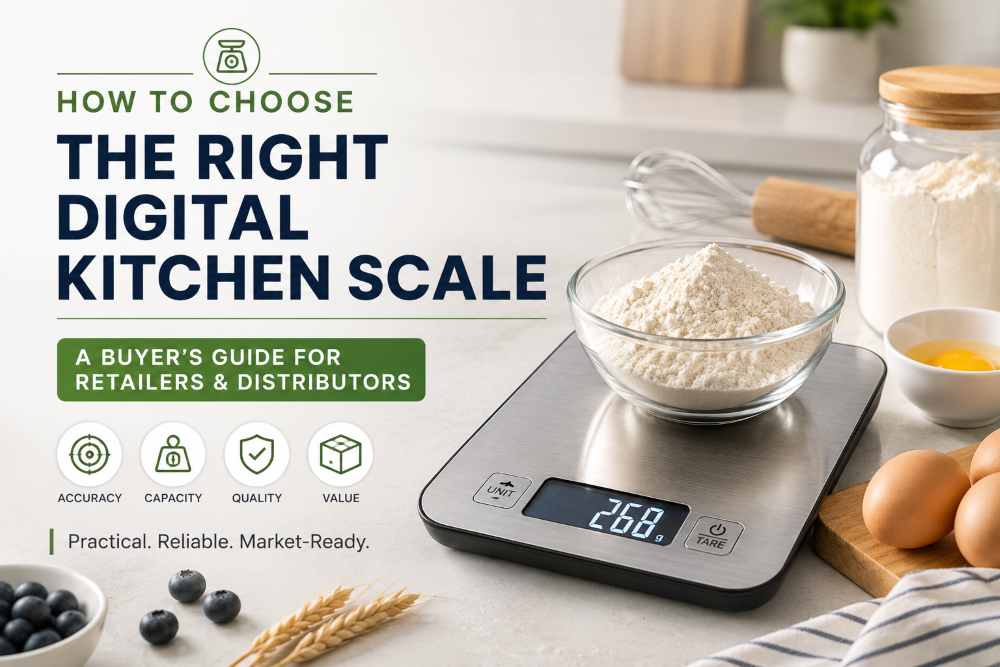
Choosing a digital kitchen scale is not simply about finding a product with a good price.
For retailers, importers and distributors, the right kitchen scale needs to match the target market, consumer needs, retail price, product design, packaging requirements and applicable regulations.
A product that performs well in one market may not necessarily be the right choice for another.
So, how should buyers evaluate a digital kitchen scale before adding it to their product range?
Here are the key factors to consider.
1. Start with Your Target Consumer
Before comparing product specifications, understand who will actually use the kitchen scale.
Different consumer groups may have very different expectations.
For example:
Home Bakers
Consumers who enjoy baking usually care about measurement accuracy and easy operation.
A scale with a clear display, tare function and fine measurement increments can be attractive for this group.
Everyday Home Cooks
For general cooking, consumers usually prefer a simple, compact and easy-to-store product.
They may value:
-
Easy-to-read display
-
Simple controls
-
Tare function
-
Compact size
-
Easy cleaning
Coffee Enthusiasts
Coffee preparation requires accurate measurement of coffee beans and water.
For this segment, a more precise scale with a modern design may be a better fit.
Health-Conscious Consumers
Consumers interested in portion control may look for a scale that provides accurate measurements and supports different units.
Understanding your target consumer first makes it much easier to select the right product specifications.

2. Choose the Right Capacity
Capacity is one of the first specifications buyers should consider.
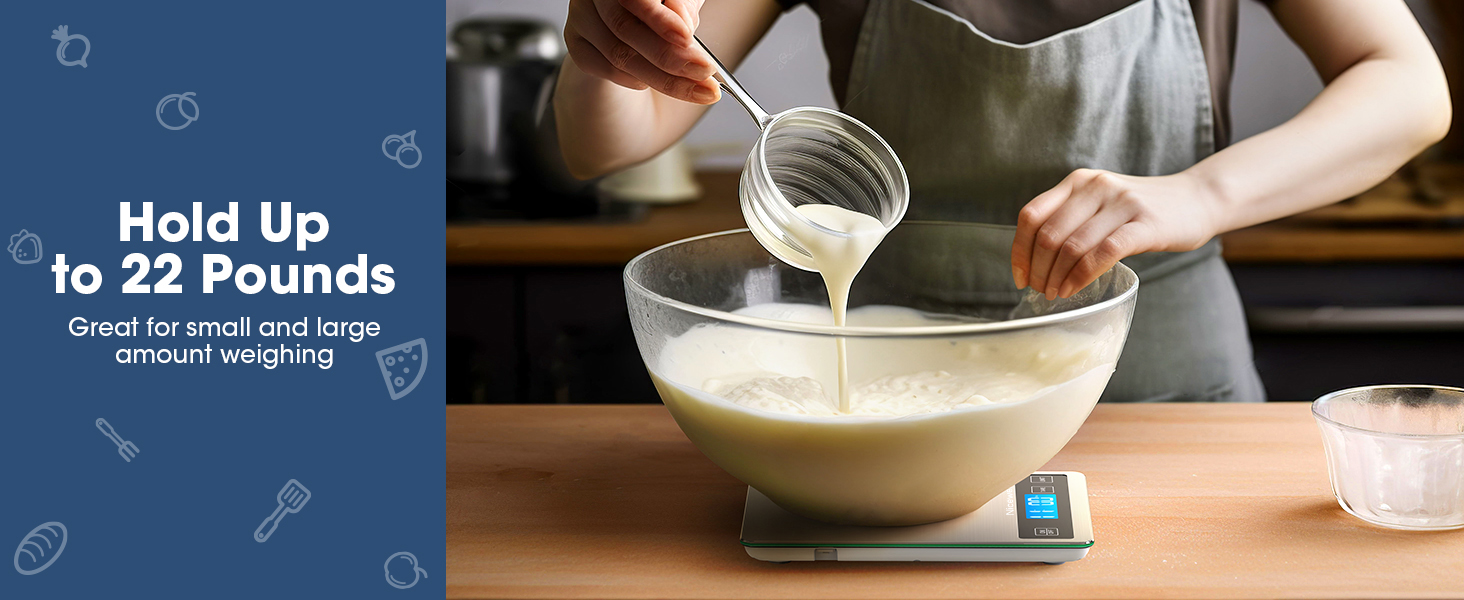
Common digital kitchen scales are designed for everyday household quantities, but the ideal capacity depends on the target market and intended use.
For example, a compact scale designed for baking and general food preparation may focus on convenience and precision, while a larger platform can be more suitable for users who regularly weigh larger ingredients or containers.
When selecting a product, consider:
-
Typical household usage
-
Target consumer
-
Product size
-
Platform size
-
Retail positioning
-
Packaging dimensions
A larger capacity does not automatically mean a better product.
The goal is to choose a capacity that matches the actual needs of your target consumers.
3. Consider Measurement Accuracy
Accuracy is one of the most important selling points of a digital kitchen scale.
However, buyers should look beyond simply asking whether a product is "accurate."
The measurement increment also matters.
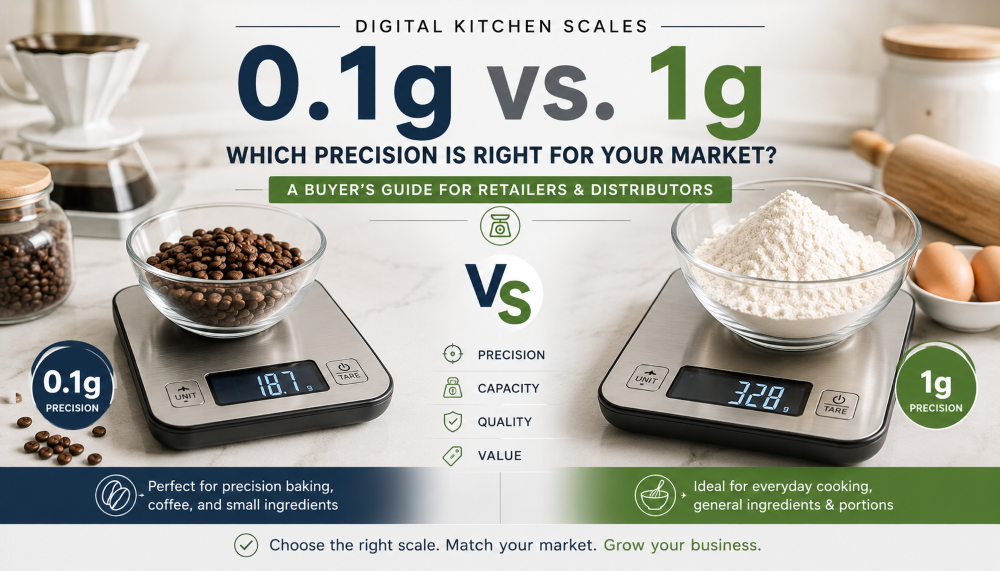
For example, a scale designed for general cooking may use a 1 g increment, while a more precision-focused model may offer a 0.1 g increment.
A 0.1 g digital kitchen scale can be particularly attractive for applications where smaller differences matter, such as baking, coffee preparation and portion measurement.
When comparing products, buyers should consider:
-
Measurement increment
-
Maximum capacity
-
Sensor performance
-
Repeatability
-
Stability of readings
The right specification depends on the market positioning of the product.
There is no need to add unnecessary precision if the target consumer does not need it.
4. Look at the Tare Function
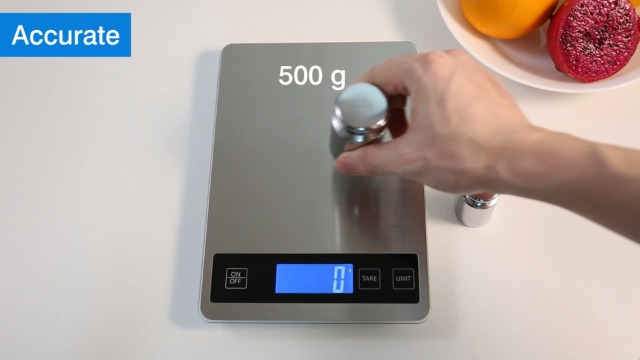
The tare function may seem like a small feature, but it is extremely useful in everyday cooking.
It allows users to reset the scale to zero after placing a bowl or container on the platform.
This means users can add ingredients one after another without calculating the weight of the container.
For example:
-
Place a mixing bowl on the scale.
-
Press Tare.
-
Add flour.
-
Press Tare again.
-
Add sugar.
-
Continue with the next ingredient.
For a household kitchen scale, a quick and reliable tare function should be considered a basic usability feature.
5. Check the Design and Materials
Functionality is important, but design also influences purchasing decisions.
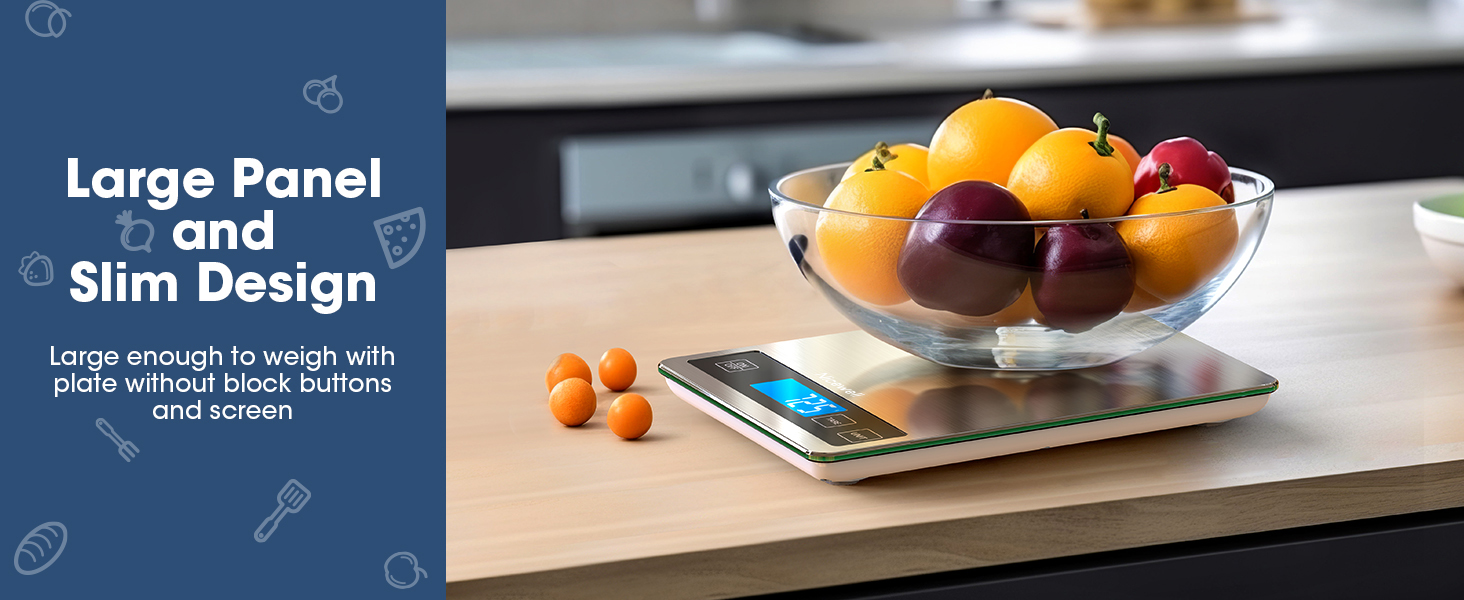
Kitchen scales are often displayed in highly competitive retail environments. A clean and modern design can help a product stand out both on the shelf and in online stores.
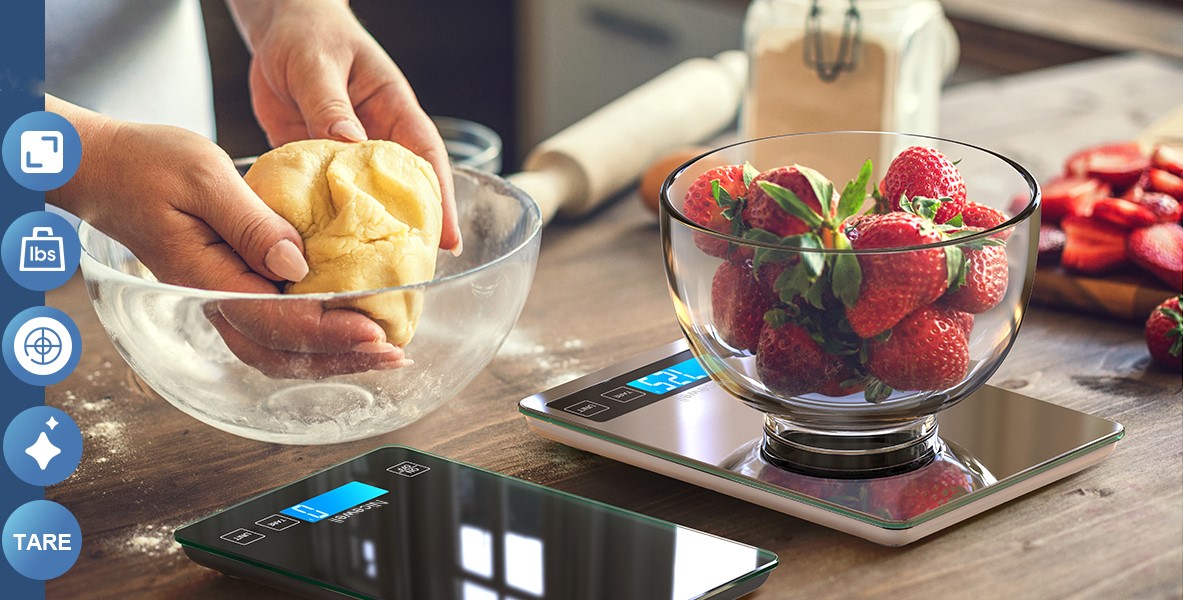
Popular design considerations include:
-
Slim profile
-
Tempered glass platform
-
Stainless steel surface
-
Large LCD display
-
Touch buttons
-
Minimalist appearance
-
Easy-to-clean surfaces
The best design depends on the market.
For example, a minimalist glass scale may suit a modern homeware collection, while a stainless steel design may fit a more professional or premium kitchenware range.
For private-label products, buyers can also consider customized colors, logos and packaging to create a more distinctive product identity.
6. Consider the Display and User Experience
A kitchen scale may have excellent technical specifications, but if the display is difficult to read, the overall user experience will suffer.
A good display should be:
-
Clear
-
Easy to read
-
Large enough for everyday use
-
Visible under normal kitchen lighting
Backlit displays can provide additional convenience, particularly for consumers who use the scale in different lighting conditions.
The control layout should also be intuitive.
Consumers should be able to understand functions such as:
-
Power
-
Tare
-
Unit conversion
without needing complicated instructions.
Simple operation is often more valuable than adding too many functions.
7. Select the Right Measurement Units
Different markets may have different preferences for measurement units.
Common options include:
-
g
-
kg
-
oz
-
lb
-
ml
When developing a kitchen scale for a specific market, buyers should check which units are most relevant to local consumers.
For products sold internationally, multiple-unit functionality can provide greater flexibility.
However, the user interface should remain simple and easy to understand.

8. Think About Battery and Power Options
Power requirements can affect both product design and the user experience.
Many digital kitchen scales use replaceable batteries, while some newer models use rechargeable power solutions.
Each option has advantages.
Replaceable Batteries
Advantages may include:
-
Easy replacement
-
No charging cable required
-
Familiar to consumers
-
Convenient for long-term storage
Rechargeable Models
Advantages may include:
-
Convenient charging
-
No regular battery replacement
-
Suitable for consumers who prefer rechargeable products
For buyers, the choice should depend on the target market, product positioning and expected retail price.
If the product contains batteries, buyers should also consider the applicable transportation, labeling and market requirements.
9. Don't Ignore Cleaning and Daily Maintenance
Kitchen products come into contact with food and ingredients, so ease of cleaning is an important part of product design.
A smooth platform with fewer gaps and complicated structures can make cleaning easier.
Materials and surfaces should also be suitable for the intended application.
For food-contact components, buyers should make sure that the supplier can provide the appropriate documentation and test reports required for the target market.
This is particularly important when developing products for European markets.

10. Check Compliance Before Placing an Order
Compliance should be considered at the beginning of the product selection process, not after the product has already been developed.
The exact requirements depend on the product configuration and destination market.
For digital kitchen scales, buyers may need to consider areas such as:
-
Electrical safety
-
Electromagnetic compatibility
-
RoHS requirements
-
Food-contact materials, where applicable
-
Battery-related requirements, where applicable
-
Packaging and labeling
-
Market-specific documentation
For European markets, buyers may commonly request documents such as CE and RoHS-related compliance documentation, while food-contact components may require relevant food-contact testing depending on the product construction and intended use.
The supplier should be able to clearly explain which tests and documents apply to the specific product.
It is also important to verify that the documentation matches the actual product being supplied.
11. Consider Your Target Retail Price
A common mistake is to select the product first and think about the retail price later.
For retailers and distributors, it is usually better to work backwards from the target market.
Consider:
Target Retail Price → Required Product Positioning → Product Specification → Packaging → Target Cost
For example, a basic kitchen scale for a value-focused retail channel may prioritize:
-
Competitive cost
-
Simple design
-
Essential functions
-
Efficient packaging
A premium kitchen scale may require:
-
More refined materials
-
Higher perceived design value
-
Greater measurement precision
-
Premium packaging
-
Stronger product presentation
The best product is not necessarily the one with the most features.
It is the product that provides the right balance between function, quality, design and cost for your market.
12. Think About Packaging and Retail Presentation
Packaging can have a significant impact on how a product is perceived.
For retail buyers, packaging should protect the product while clearly communicating its key selling points.
Important considerations may include:
-
Product images
-
Main features
-
Specifications
-
Usage information
-
Barcode
-
Country-specific labeling
-
Multilingual instructions
-
Retail display requirements
For private-label projects, customized packaging can also help maintain a consistent brand identity across the product range.
A good kitchen scale with poor packaging may struggle to perform as well as a well-presented product with a similar specification.
13. Choose a Supplier That Can Support Your Market
Product selection is only one part of the process.
The supplier behind the product can have an equally important impact on the success of a project.
When evaluating a kitchen scale manufacturer or supplier, consider:
Product Development
Can the supplier provide existing models as well as customized solutions?
Quality Control
Does the supplier have a clear quality-control process?
Compliance Support
Can they provide relevant test reports and documentation for your target market?
OEM & ODM Capability
Can they customize colors, logos, packaging or product specifications?
MOQ
Is the MOQ suitable for your initial order quantity?
Lead Time
Can the supplier meet your expected delivery schedule?
Communication
Can they respond clearly and quickly when technical or production questions arise?
A supplier that understands your market can often help you avoid unnecessary product changes later.
14. A Simple Checklist for Buyers
Before selecting a digital kitchen scale, ask the following questions:
Target Market
-
Who is the target consumer?
-
What is the expected retail price?
-
Which sales channels will be used?
Product
-
What capacity is required?
-
Is 1 g or 0.1 g precision more suitable?
-
Which measurement units are needed?
-
Is the tare function included?
-
What display and design are appropriate?
Quality
-
Are the materials suitable for the intended use?
-
Is the platform easy to clean?
-
Has the product been tested for performance and durability?
Compliance
-
What regulations apply in the destination market?
-
What test reports and documents are available?
-
Do the documents correspond to the actual product?
Commercial
-
What is the MOQ?
-
What is the lead time?
-
Is OEM or ODM customization available?
-
Can the supplier support future product development?
Answering these questions before placing an order can help reduce product development risks and improve the chances of a successful market launch.
Why Work with One Ants for Digital Kitchen Scales?
At One Ants, we develop and supply practical kitchen and household products for international retailers, importers, distributors and brands.
Our digital kitchen scale range covers different designs, specifications and market positioning, from practical everyday models to more precision-focused products for baking and food preparation.
We can support projects with:
-
Digital kitchen scales
-
Different capacities and measurement increments
-
Customized colors and branding
-
OEM and ODM development
-
Retail packaging
-
Product documentation
-
Flexible MOQ options
-
International export experience
Our focus is not simply on supplying a product.
We work with customers to find a kitchen scale that fits their target market, retail positioning and product requirements.
Conclusion
Choosing the right digital kitchen scale requires more than comparing prices.
The right product should match your target consumer, required capacity, measurement precision, design preferences, retail price and applicable market requirements.
For retailers, importers and distributors, working with an experienced kitchen scale supplier can also make product development, customization and compliance preparation much easier.
If you are looking for digital kitchen scales for your market, we would be happy to discuss your requirements and recommend suitable models.
Contact One Ants to explore our latest digital kitchen scale range and OEM/ODM options.
0.1g vs. 1g Kitchen Scales: Which Is Right for Your Market?